
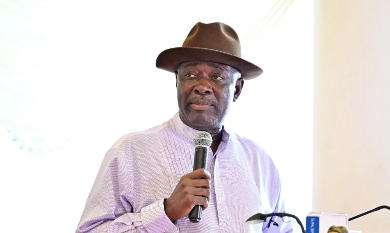
The Minister of State for Petroleum Resources (Oil), Heineken Lokpobiri, has said the Federal Government cannot directly reduce or increase the price of petrol because the downstream petroleum sector is fully deregulated.
Lokpobiri made the statement during an appearance on Channels Television’s Politics Today on Tuesday, explaining that petrol prices are influenced by global market conditions rather than directly determined by the government.
According to the minister, “The Bola Tinubu government doesn’t have any power to reduce or increase the price of petrol. It is completely deregulated in line with global best standards.”
He explained that crude oil and refined petroleum products are traded internationally, making it difficult for Nigeria to independently determine pump prices without reintroducing a subsidy regime.
“Crude oil and refined products are a global business. Nigeria doesn’t exist in isolation. You cannot arbitrarily reduce prices unless you want to roll back to subsidy,” he said.
Lokpobiri was responding to calls by former Vice President Atiku Abubakar for a production subsidy that would make locally refined petrol more affordable to Nigerians. The minister rejected the proposal, arguing that Atiku’s suggestion lacked legal, fiscal and financial basis.
He also disagreed with the argument that petrol refined locally should automatically be significantly cheaper because it is produced at the Dangote Refinery.
According to Lokpobiri, locally produced crude supplied to refineries is still priced according to international market conditions.
“They sell crude to the refinery at the same global price,” he said.
The minister nevertheless maintained that Nigerians were already benefiting from local refining, particularly through improved availability of petroleum products and comparatively lower pump prices.
“We already benefit. That’s why our price is lower than that of the U.S.,” Lokpobiri said.
He further argued that the impact of global energy prices is not unique to Nigeria, noting that consumers in other major economies are also affected by movements in the international oil market.
Lokpobiri also defended the Tinubu administration’s decision to remove the petrol subsidy in May 2023, saying the policy was implemented at the appropriate time and had freed resources for other areas of the economy.
The minister’s comments come amid renewed political debate over petrol prices ahead of the 2027 presidential election, with opposition presidential candidate Atiku Abubakar advocating a production subsidy aimed at reducing the cost of locally refined fuel.
The Nigerian Midstream and Downstream Petroleum Regulatory Authority has similarly stated that fuel prices are subject to market volatility, with factors including crude-oil sourcing, refining, logistics and transportation costs contributing to changes in pump prices.
