

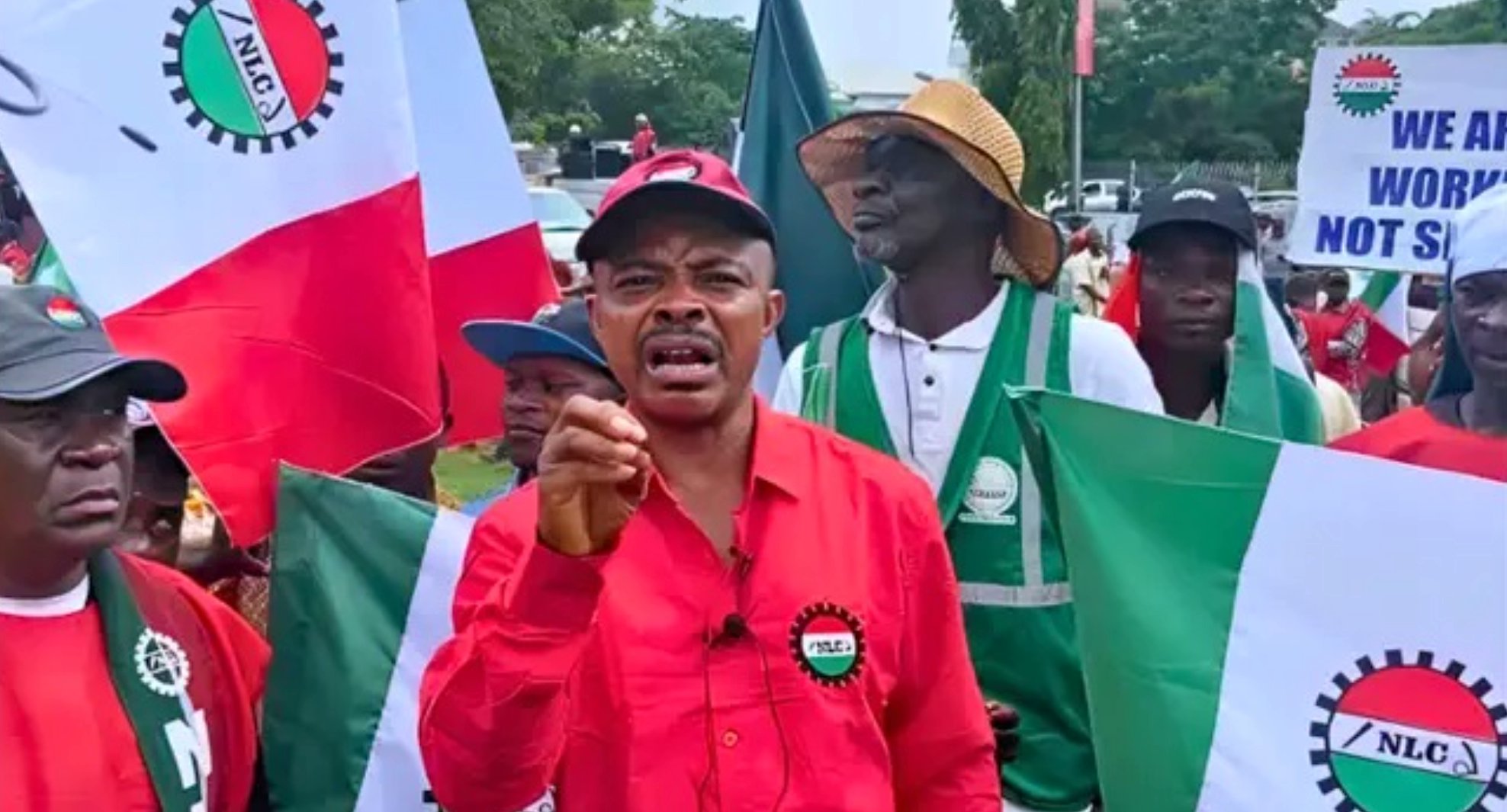
The Nigeria Labour Congress (NLC) has rejected the suggestion of a N100,000 minimum wage being considered by state governors, arguing that workers need far more to cope with the country’s economic realities.
Speaking in an interview on Sunday, NLC spokesperson Benson Upah said a wage of N100,000 would be inadequate given the soaring cost of living, adding that a more realistic figure could be as high as N1 million.
His comments came after the Chairman of the Nigeria Governors’ Forum and Governor of Kwara State, AbdulRahman AbdulRazaq, revealed that governors were discussing the possibility of increasing the national minimum wage to N100,000.
AbdulRazaq made the disclosure while speaking during a Sallah visit to President Bola Tinubu in Lagos. He explained that consultations were ongoing between governors, the Federal Government and organised labour to reach a wage agreement that would improve workers’ welfare without placing excessive pressure on government finances.
The governor also noted in a Facebook post that rising inflation, increasing living expenses and the growing financial challenges facing workers informed the proposal.
Responding to the development, Upah acknowledged the governors’ willingness to review workers’ salaries but insisted that the amount under consideration fell well short of what Nigerian workers currently require.
According to him, factors such as the continued depreciation of the naira, high inflation, increased electricity tariffs, rising petrol prices, declining purchasing power and the effects of new tax policies have significantly worsened living conditions.
He maintained that if current economic conditions remain unchanged, a monthly wage of N1 million would better reflect the realities faced by workers across the country.
Upah further argued that governments now have stronger revenue streams and should be able to provide better remuneration for workers. He pointed to allocations shared through the Federation Account Allocation Committee (FAAC) and additional earnings linked to global oil market developments as evidence that governments are in a stronger financial position.
The labour leader also stressed that the workforce remains the backbone of national development and should be adequately rewarded to boost productivity and economic growth.
The debate over wages has continued since the Federal Government removed fuel subsidies and floated the naira, policies that contributed to a sharp increase in living costs.
In July 2024, the Federal Government approved a new national minimum wage of N70,000 after months of negotiations with organised labour, replacing the previous N30,000 wage introduced in 2019.
Despite that increase, labour unions have repeatedly argued that the current wage can no longer meet workers’ basic needs as inflation and household expenses continue to rise.
While governors have discussed a possible review, the Nigeria Governors’ Forum is yet to formally submit a new minimum wage proposal to either the Federal Government or organised labour.